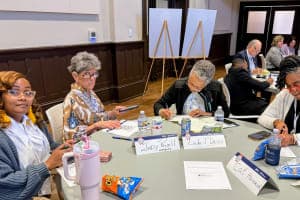
More than 50 mayors gathered on the University of Georgia’s campus on August 28-30 for the second offering of the immersive Mayors Leadership Academy, presented by the Harold F. Holtz Municipal Training Institute, operated in partnership between GMA and UGA’s Carl Vinson Institute of Government.
“Georgia’s mayors are called on every day to make important decisions, bring people together and lead their communities through both opportunities and challenges,” said GMA CEO and Executive Director Larry Hanson. “The Georgia Mayors Leadership Academy gives them dedicated time to strengthen those skills, learn from one another and return home better prepared to serve their cities.”
“Strong communities depend on strong leadership, and the Mayors Leadership Academy represents an important investment in the people who lead Georgia’s cities,” said UGA’s Carl Vinson Institute of Government (CVIOG) Director Rob Gordon. “In its second offering, the academy is building a growing network of mayors who can learn from one another and strengthen their capacity to lead. We are proud to partner with GMA to support these city leaders as they shape the future of communities across Georgia.”
During the Academy welcome remarks, Madison Councilmember and Municipal Training Board Chair Carrie Peters-Reid offered a councilmember’s-eye view of leadership, encouraging mayors to fully step into their role as presiding officer, be visible in their communities — and to lead, first and foremost, with kindness.
It was a fitting way to begin, because the day would go on to explore leadership from nearly every angle a mayor might face: emotional, relational, strategic, and personal.
University of Georgia mental health professional Perris Oyagha led an introspective discussion on mental health offering mayors practical strategies for finding balance and protecting their own well-being. “It’s okay to say no,” he told the mayors and reminded them “to schedule rest just like you schedule anything else.”

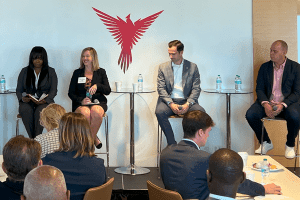
That permission — to set limits, to protect your own capacity — echoed later in the day when GMA Deputy Executive Director Jim Thornton walked mayors through the many roles they’re asked to play , reminding the mayors that they also have a role to teach their communities about how government works. Thornton also moderated a panel on the various roles of mayors featuring Jackson Mayor and GMA Second Vice President Carlos Duffey, Peachtree City Mayor Kim Learnard, and Valdosta Mayor Scott James Matheson. All three offered leadership fundamentals that included: stay close to your community, work hand-in-hand with your council, and never stop preparing.
No mayor gets to choose when a crisis lands on their desk — but they do choose how they respond to it. Communications professional Nelly Miles advised mayors through the work of leading through a crisis, framing the mayor’s role as one of setting the tone and values for a community and helping the public understand what's happening and why.
Day One of the program closed with a visit to the UGA football stadium and remarks from UGA Director of Men’s and Women’s Track and Field and Cross Country, Coach Caryl Smith Gilbert, who drew a striking parallel between coaching a championship team and leading a city: neither is built by people who avoid pressure. Both are built by people who know how to run through it. She also encouraged the mayors to stay true to who they are and focus on their top priorities. The rest of the Academy filled in a fuller picture of what it takes to lead a city well:
- CVIOG Senior Public Service Associate Walt McBride opened day two exploring the mayor's role in leading change, distinguishing between technical problems and adaptive challenges — the kind that require mobilizing collaboration rather than simply issuing solutions.
- GMA CEO and Executive Director Larry Hanson led an interactive session on the trends, challenges, and emerging issues shaping municipal government, giving mayors space to discuss how these issues are playing out in their own cities.
- Rome City Manager Sammy Rich, Duluth Assistant City Manager/City Clerk Teresa Lynn, and Albany Police Chief Michael Persley spoke on leading through relationships — the connective tissue that holds city government together.
- Hart County Archway Professional Dr. Rosanna Cruz-Bibb, Gwinnett County Board of Commissioners Chairwoman Nicole Love Hendrickson, Heart of Georgia Altamaha Regional Commission Executive Director Brett Manning, and Gwinnett Chamber of Commerce President Nick Masino examined the mayor's role as convenor — reminding mayors that some of the most important work happens when you break bread with your county counterparts and community stakeholders.
- GMA Member Services Consulting Director Freddie Broome spoke on civility and ethics in city leadership, with a piece of advice that lingered: don't take it personally.
- To begin day three, Young Harris Mayor and GMA President Andrea Gibby led a session on the mayor as mediator, urging mayors to stay calm when others become emotional — because trust, she noted, begins with self-awareness.
- The Academy closed with remarks from Hon. Rev. Dr. John R. Unger II, who spoke on building strong communities in an era of continuous change, leaving mayors with a challenge to build trust before urgency demands it and urged mayors to continue to learn.

Some of the most honest moments didn't happen on stage — they happened in the reflections mayors shared at the end of the Academy. “I am not in this alone,” one mayor reflected. Another put it simply: “I have new friends and new colleagues — people I can call.” More than one talked about wanting to be more intentional about their relationships going forward, and about resisting the urge to think of life as it used to be, choosing instead to imagine what it could be.
Visibility came up as more than a talking point — it’s a practice. “I am going to become more visible,” one mayor said. “Be aware. Go around to all the merchants, one on one. Become more active in the entire county.” Visibility, another added, gives people a sense of comfort.
There was also permission — to rest, and to let go of the pressure to have every answer. “Take time for yourself. Go home,” one mayor said. “I don't have to be the smartest guy in the room,” said another. “People want to be useful.”

And there was a recurring, pointed question about who gets heard. “The thing that resonated is: who is missing from the conversation,” one mayor noted — a challenge to transform people who simply live in a city into citizens who help build it, and to limit the outsized influence of the same handful of loud voices that can dominate a room. Several mayors agreed with Rev. Unger who said great leaders keep small circles — people they can talk with honestly, be vulnerable with, and share the real weight of the job with. The work, in the end, is about being intentional: intentional about who’s at the table, intentional about what you do, and intentional about how you listen.
By the end of the program, more than one mayor described feeling something they hadn’t expected to find at the Academy: renewed zeal and restored passion.